
Binance hacked: what to do now? Withdrawals, refunds and safety
Binance was hacked on October 29, 2026, with about $6.3 billion stolen from the exchange’s wallets.
If you hold funds there, the question is natural: Binance was hacked — now what?
The short answer: your balance was not touched, and Binance says it will cover the full loss.
But this is exactly when scammers strike hardest, so a few precautions make a difference.
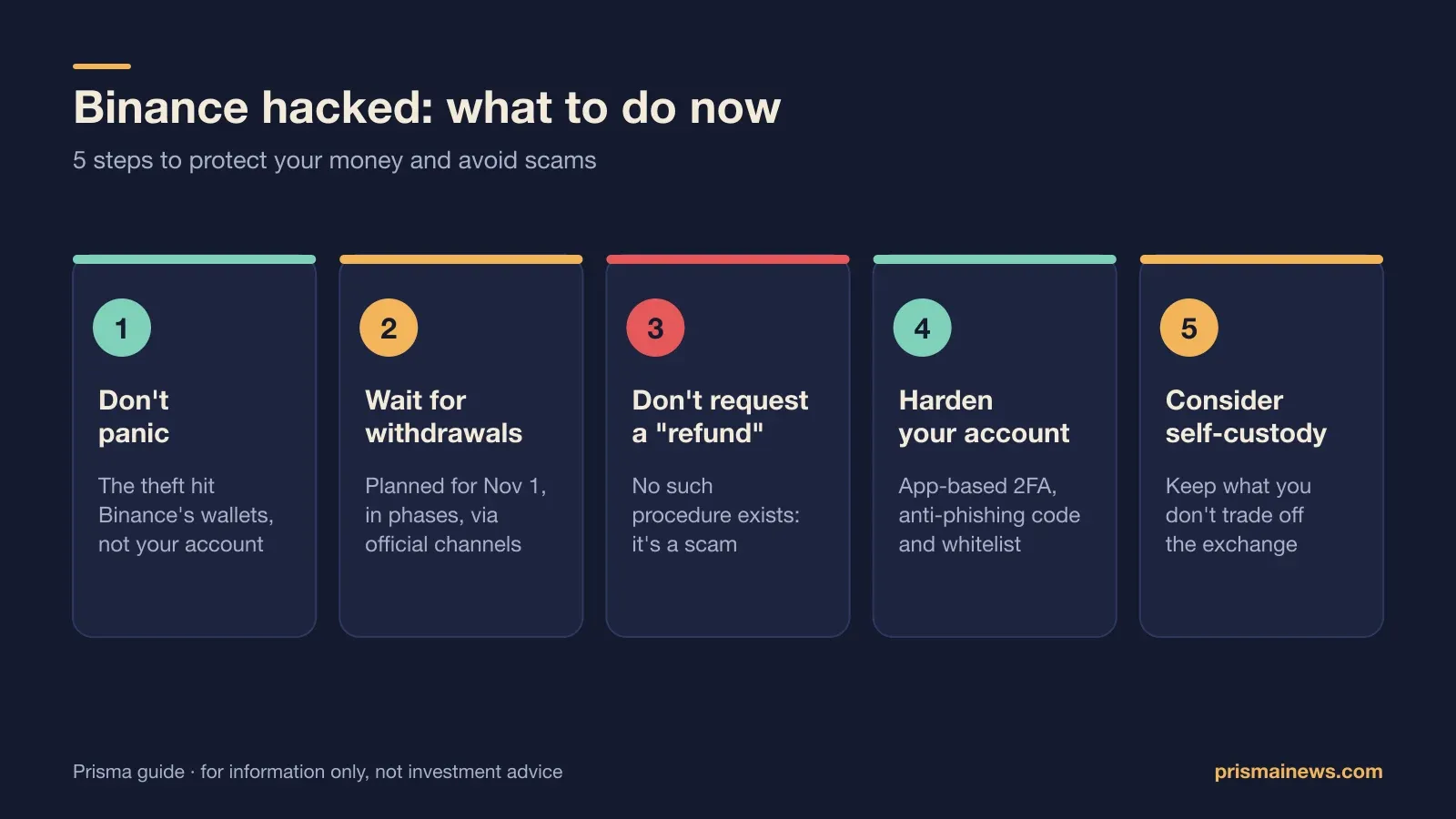
Quick answer: what to do now
- Don’t panic — the theft hit Binance’s wallets, not your account.
- Wait for withdrawals to return, scheduled for Sunday (Nov 1), in phases.
- Don’t request a “refund” on websites or social profiles: no such procedure exists.
- Turn on the anti-phishing code and review your account security.
- Consider self-custody for funds you don’t actively trade.
Is my money safe on Binance?
The attack hit hot wallets, the online wallets Binance uses to process withdrawals for all customers.
Individual balances remain recorded in your account.
Binance said users will not bear the loss and set aside more than $6.34 billion of its own funds.
On Saturday (Oct 31), the exchange said it had already replenished 90% of affected assets, according to CNBC.
BTC, ETH, USDT, BNB, SOL, USDC, XRP, USD1, RLUSD and ZEC are fully backed 100%, according to Binance.
The remaining 10% are less liquid tokens that will be bought on the market.
To understand the attack in detail, read how the Binance hack happened.
Binance withdrawals suspended: when do they come back?
Binance suspended withdrawals at 22:15 UTC on Oct 29, about two hours after the attack began.
The official plan is to resume withdrawals on Sunday, November 1, in phases and subject to security checks.
That means some networks and coins may return before others.
Follow only official announcements in the Binance app and website.
If a withdrawal stays pending in the first hours, be patient: demand will likely be high right after reopening.
Binance refund: do I need to request anything?
No. There is no form or refund request to submit.
Coverage happens inside Binance itself, using the SAFU emergency fund, part of the futures insurance fund and the company’s treasury.
Any website, email, text, profile or group offering a “Binance refund” should be treated as a scam.
Watch out for scams after the hack
Major incidents are often followed by phishing waves that exploit users’ fear.
Watch for these signs:
- Messages asking for your seed phrase, password or 2FA code. Binance never asks for these.
- Links to “verify your account” or “unlock your balance”.
- Fake support profiles on X, Telegram, Instagram or WhatsApp.
- Requests to move crypto to a “safe wallet”.
- Calls from supposed Binance agents.
Binance’s anti-phishing code helps separate official emails from fakes: legitimate emails will display a code only you know.
How to secure your Binance account
The hack did not involve customer accounts, but this is a good time to review your security:
- Turn on two-factor authentication with an authenticator app or security key, rather than relying on SMS alone.
- Set up the anti-phishing code in your security settings.
- Enable the withdrawal address whitelist.
- Review connected devices and end sessions you don’t recognize.
- Use a unique password for Binance and for the email linked to it.
Is Binance safe after the hack?
According to Sean Farrell of Fundstrat, speaking to CNBC, the attack does not appear to create meaningful solvency risk for Binance.
The key signal to watch, he said, is how quickly withdrawals resume and whether outflows stay orderly.
Still, the episode reinforces an old crypto rule: no exchange is risk-free.
Binance itself suffered a 7,000 BTC theft in 2019, which was covered by the SAFU fund.
Should I withdraw everything from Binance?
There is no reason to panic, and a bank run helps no one.
But you don’t need to keep all your holdings on an exchange either.
A common split is to keep on the exchange only what you trade and hold the rest in self-custody.
With self-custody, you control the keys, in a hardware wallet or a trusted wallet app.
In exchange, the responsibility is yours: losing your seed phrase means losing access to your funds.
What about the Bitcoin price?
Bitcoin fell about 5% after the announcement and traded below $78,000 on Friday (Oct 30), according to CNBC.
Sharp moves are common after major hacks, and panic decisions tend to be expensive.
If you buy or sell, do it with a plan, not on impulse.
Read next
- Binance hacked: how the biggest crypto heist in history happened
- EIP-7702: the feature used in the Binance hack and how to protect your wallet
This content is for information only and is not investment advice.
Source: CNBC